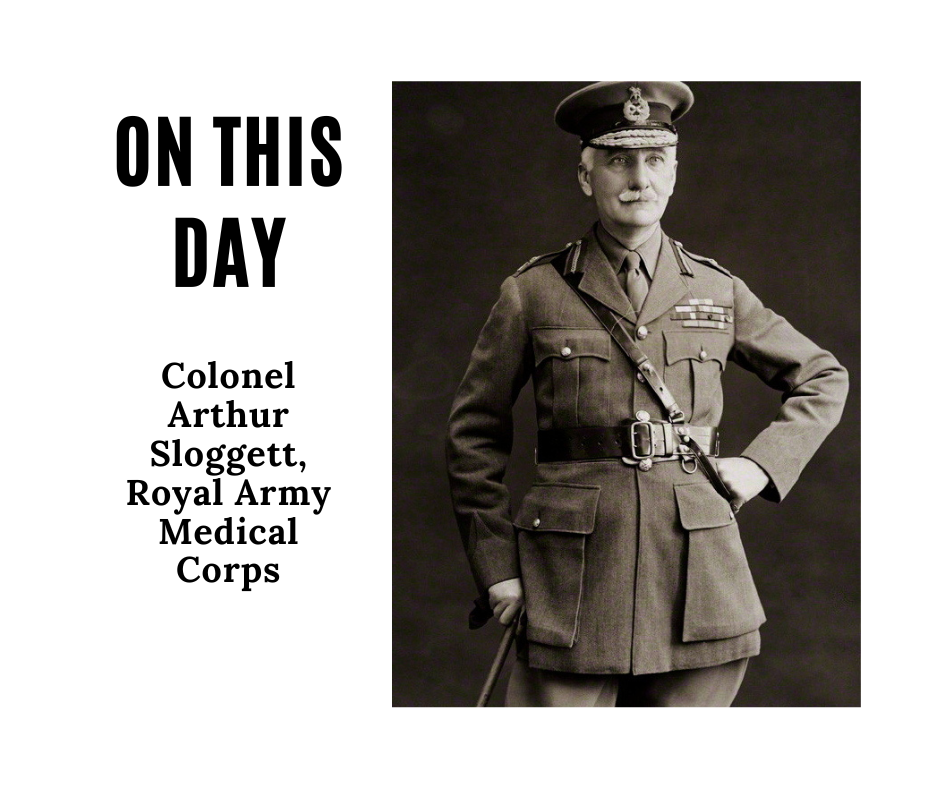
When Duty Called: Colonel Arthur Sloggett, Wounded Tending the Fallen at Omdurman
On 2 September 1898, at the Battle of Omdurman in Sudan, Arthur Sloggett was shot clean through the chest while treating wounded soldiers under fire. He was Senior Medical Officer of the 1st Brigade, British Division, and his horse was shot from under him in the same action. He survived both wounds. Decades later, he would lead Army medical services throughout the First World War.
His story is a reminder that RAMC officers have never stood apart from danger. They have stood inside it, armed with nothing but medical skill and nerve.
The Battle of Omdurman: Britain's Decisive Day in Sudan
Omdurman was the climax of General Sir Herbert Kitchener’s campaign to reconquer Sudan. On the morning of 2 September, tens of thousands of Mahdist warriors launched a series of attacks against the British and Egyptian lines. Later that same morning, the 21st Lancers made their now-famous cavalry charge against a hidden Mahdist force on the British right flank.
Consequently, the battle became one of the most written-about actions of the Victorian army, thanks partly to a young war correspondent named Winston Churchill, who rode with the Lancers that day. However, the real story of medical courage at Omdurman was unfolding elsewhere on the field, among the infantry brigades and their doctors.
A Doctor Under Fire
Sloggett was no stranger to combat by 1898. Two years earlier, during the 1896 Dongola Campaign, he had served as senior medical officer of British troops in Sudan and was mentioned in dispatches for his conduct. Because of this experience, he was a natural choice to serve as senior medical officer of the 1st Brigade at Omdurman.
As a result, he found himself directly in the line of fire when the battle turned fierce. Contemporary newspaper reports from the time confirm he was “shot clean through the chest” while attending to casualties, and that his horse was killed under him during the same engagement. Remarkably, he recovered and returned to duty.
From Battlefield Doctor to Director-General
Sloggett’s Omdurman wound did not slow his career. He went on to serve throughout the Second Boer War from 1899 to 1902, commanding an Imperial Yeomanry hospital and later a general hospital. He was mentioned in dispatches again in 1901 and was invested as a Companion of the Order of St Michael and St George in 1903.
Therefore, by 1908 he had reached the rank of Surgeon-General. He then served as Principal Medical Officer of the 6th (Poona) Division in India, before being appointed Director of Medical Services in India. On 1 June 1914, he was appointed Director General of the Army Medical Services, the most senior medical post in the British Army.
A War Fought From the Front
The First World War broke out two months after Sloggett’s appointment. Rather than run the medical services from a desk in London, he crossed to France on 28 October 1914 to become Director-General of Medical Services for the British Expeditionary Force. He remained there for nearly four years, until his term of office ended in June 1918, and was mentioned in dispatches a further seven times for his wartime service.
Honours followed steadily. He was made a Knight of the Order of the Bath and awarded the French Legion of Honour in 1915, then Belgium’s Order of Leopold in 1916. In 1917 alone, he was invested as a Knight Commander of both the Order of St Michael and St George and the Royal Victorian Order, and was elected a Fellow of the Royal College of Surgeons.
Why Sloggett's Story Still Matters
The RAMC motto, In Arduis Fidelis — Faithful in Adversity — was never just a phrase on a badge. Sloggett’s actions at Omdurman show exactly what that adversity looked like in practice: staying forward with the wounded while under direct fire, accepting personal risk as simply part of the job.
Sloggett died suddenly on 27 November 1929, while walking with his son near Regent’s Park in London. He is buried alongside his wife, Helen, at St Peter’s Church, Petersham.
Quick facts:
- Date: 2 September 1898, Battle of Omdurman, Sudan
- Role: Senior Medical Officer, 1st Brigade, British Division
- Wounds: Shot through the chest; horse killed under him
- Later career: Director General Army Medical Services, 1914; Director-General of Medical Services, British Expeditionary Force, 1914–1918
- Honours: Knight of the Order of the Bath, KCMG, KCVO, Legion of Honour, Order of Leopold
His example still resonates today, since it captures a truth that runs through RAMC history from the Sudan to the present: medical officers serve where the danger is, not away from it.