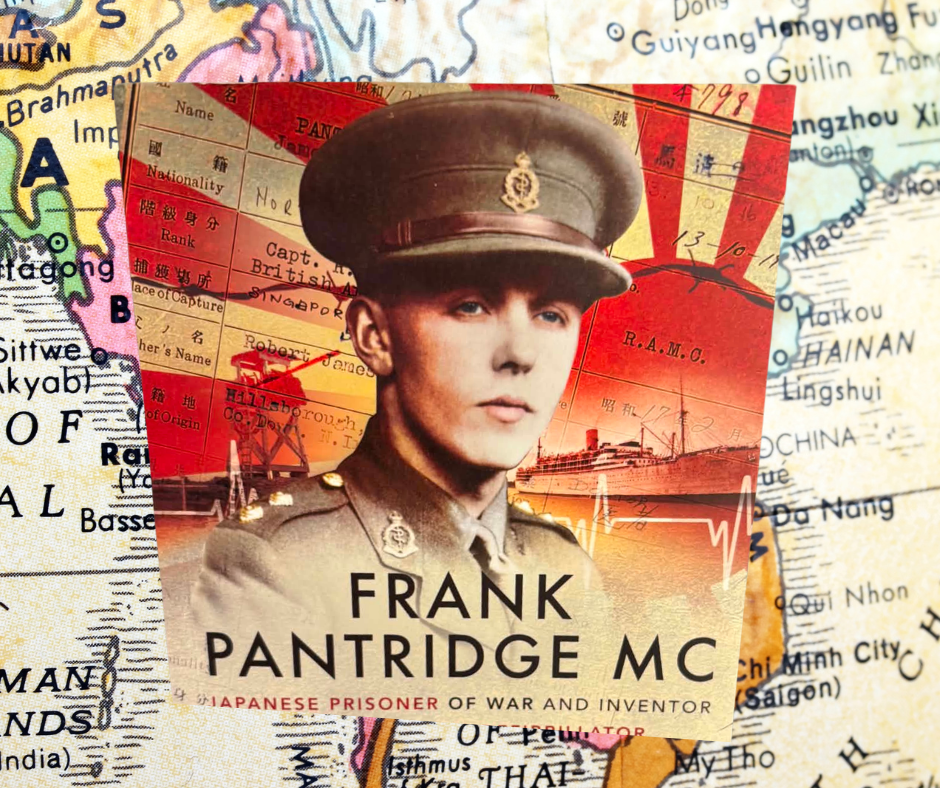
Frank Pantridge MC: The RAMC Doctor Who Invented the Portable Defibrillator
Every time an AED shocks a heart back to life, the story begins with one man: Frank Pantridge MC. He was a Royal Army Medical Corps doctor, a Japanese prisoner of war, and the father of emergency medicine. His journey from the Burma Railway to a Belfast ambulance produced one of the most important medical inventions of the twentieth century.
This is a story every RAMC member should know.
From Hillsborough to the RAMC
James Francis Pantridge was born on 3 October 1916 in Hillsborough, County Down. He trained at Queen’s University Belfast and graduated in medicine in 1939. Within weeks of finishing his studies, Britain declared war on Germany.
Pantridge volunteered immediately. The RAMC commissioned him as a lieutenant in April 1940. Although conscription did not apply in Northern Ireland, he did not hesitate. Notably, an early posting to Norway fell through because he could not ski — a fortunate escape, since almost everyone on that expedition died.
So instead, the army sent him to Singapore, where he served as Medical Officer to the Gordon Highlanders.
Singapore, Changi, and the Burma Railway
The fall of Singapore in February 1942 changed everything. The Japanese captured Pantridge and imprisoned him in the notorious Changi prisoner of war camp. They then conscripted him into F Force and sent him to labour on the Siam-Burma Railway, where he worked alongside around 7,000 British and Australian prisoners in conditions of extraordinary brutality.
During this period, Pantridge contracted cardiac beriberi — a potentially fatal heart condition caused by severe thiamine deficiency. That he survived at all was remarkable. That he went on to transform cardiology is one of medicine’s most extraordinary stories.
The army awarded him the Military Cross for gallant and distinguished services during the Malayan campaign in 1942. Liberation came in August 1945, but it left him emaciated. Moreover, the experience of watching men die when timely intervention might have saved them never left him.
The lesson he carried home from those camps was simple and devastating: time is everything when death threatens.
Back to Belfast: and a Revolutionary Idea
After the war, Pantridge spent time at the University of Michigan working with leading electrocardiography expert Dr FN Wilson. He returned to Northern Ireland in 1950, joined the Royal Victoria Hospital in Belfast as cardiac consultant, and took up a professorship at Queen’s University. He held both roles until his retirement in 1982.
By 1957, he and colleague Dr John Geddes had already introduced a modern system of cardiopulmonary resuscitation for the early treatment of cardiac arrest.
Yet something else troubled him deeply. In the 1960s, the UK recorded over 100,000 coronary attacks each year, with around 35,000 sudden deaths in people under 70. Further study brought Pantridge to a crucial insight: most of these deaths stemmed from ventricular fibrillation within one hour of symptom onset — and mostly outside hospital.
Patients were not dying because treatment failed. They were dying before treatment could reach them.
The Invention That Changed the World
The First Portable Defibrillator, 1965
In the winter of 1965, Pantridge acted. Together with Dr John Geddes and technician Alfred Mawhinney, he took a discarded ambulance and the resources of a Belfast teaching hospital and built something entirely new: the world’s first mobile coronary care unit (MCCU).
He designed a portable defibrillator to go with it. It weighed 70 kilograms and ran off two 12-volt car batteries. It was not elegant. But it worked.
The core insight was straightforward: take the treatment to the patient, not the patient to the treatment. As a wartime medic, Pantridge had grasped the “golden hour” instinctively. He then applied that battlefield wisdom directly to civilian cardiac care. As a result, for the first time, crews could treat cardiac emergencies where they occurred.
Consequently, Belfast became the safest place in the United Kingdom to have a heart attack.
From 70kg to 3kg
Pantridge did not stop there. By 1968, he worked with engineers to design a new instrument weighing just 3 kilograms, using a miniature capacitor originally manufactured for NASA. This compact device became the true ancestor of every AED in use today.
His 1967 article in The Lancet laid out the evidence and transformed emergency medicine worldwide. Furthermore, emergency services around the world adopted the “Pantridge Plan” — pre-hospital coronary care delivered by a specially equipped unit.
In 1972, the plan even helped treat President Lyndon Johnson when he suffered a heart attack during a visit to Virginia.
Frank Pantridge MC: The Man Behind the Mission
A Character Who Did Not Conform
A Character Who Did Not Conform
Those who served or worked with Pantridge remember a man who was brilliant, outspoken, and entirely unwilling to be managed. He fell out with senior officers in Singapore. He dismissed early suggestions about pre-hospital care as “yet another idiotic idea.” Then, once he came to believe in that same idea, he pursued it with ferocious determination.
His view on public access to defibrillators became a rallying cry:
“Any lay individual who could do CPR is capable of using a defibrillator. A defibrillator should be beside every fire extinguisher. Life is more important than property.”
He said that in 1970. Nevertheless, the UK waited until 1990 — 25 years after his first ambulance-mounted device — before equipping all frontline ambulances with defibrillators. That delay cost lives.
The Japanese Paradox
There is a profound historical irony in what followed. Japan — the nation whose forces had caused such suffering to Pantridge and tens of thousands of fellow prisoners — became one of the most enthusiastic adopters of his technology. By the 1970s, Japanese manufacturers were building advanced versions of his designs. Today, Japan holds one of the highest densities of public-access defibrillators anywhere in the world.
Pantridge never fully made his peace with what had happened to him. Yet the technology he created asked no such questions of those it saved.
Recognition and Its Limits
The government awarded Pantridge a CBE in 1978. Many felt strongly that he deserved a knighthood. He never received one.
Despite this, his legacy endures in several tangible ways:
- A statue stands in his memory in Lisburn.
- A blue plaque marks the Royal Victoria Hospital, Belfast.
- Roads in Hillsborough and Belfast carry his name.
- The Ulster Transport Museum preserves the original ambulance carrying his first portable defibrillator.
- In 2015, Belfast renamed a military base the Pantridge Army Reserve Centre — home to 253 North Irish Medical Regiment.
Professor Frank Pantridge CBE MC OStJ died on 26 December 2004 in Hillsborough, aged 88. The medical world widely regards him as the father of emergency medicine.
What His Contribution Means for the RAMC
Pantridge’s story runs directly parallel to some of the RAMC’s finest traditions. Above all, he was:
- A volunteer, not a conscript, who joined without hesitation.
- A prisoner of war who endured without breaking.
- A clinician who used frontline experience to reshape civilian medicine.
- A doctor who put the patient before the institution.
In every meaningful sense, the mobile coronary care unit applied a military lesson to civilian life. Pantridge had learned on the Burma Railway that distance from care killed people. Therefore, he spent the rest of his career eliminating that distance.
Today, every AED placed in a shopping centre, railway station, or village hall continues the work he started with two car batteries and a converted ambulance in 1965.