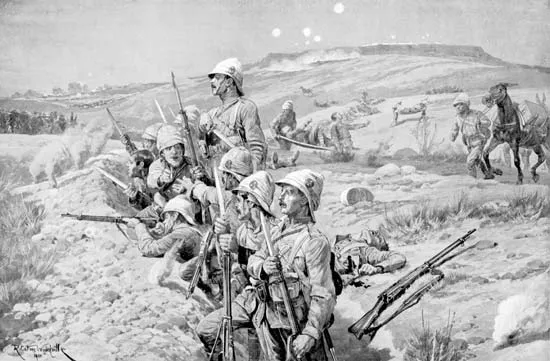
A Medical Challenge of Staggering Scale
The numbers tell a stark story. Around 500,000 British troops served in South Africa during the conflict. The RAMC treated 22,000 battle-wounded — but disease proved a far deadlier enemy.
- 74,000 soldiers were treated for dysentery and typhoid fever alone
- 8,000 men died from typhoid — more than fell to Boer bullets
- RAMC hygiene officers gave clear warnings that commanders repeatedly ignored
Water purification was defective. Sanitation was deplorable. Disease did what the Boers could not.
Moreover, the Corps itself was under-resourced and overstretched from the outset. Therefore, the failures that followed were not simply a matter of medical incompetence — they reflected a military establishment that had not yet learned to value preventive medicine.
Courage Under Fire: Victoria Crosses on the Veldt
Arthur Martin-Leake: The Man Who Won the VC Twice
Despite those failures, the South African War produced extraordinary acts of courage. Four RAMC officers earned the Victoria Cross during the conflict. Among them was Surgeon Captain Arthur Martin-Leake, whose actions at Vlakfontein in 1902 became the stuff of legend.
Under murderous fire from around 40 Boers at close range, Martin-Leake attended the wounded with complete disregard for his own safety. He was shot three times. He refused water until every other wounded man had been served first.
His bravery earned him the Victoria Cross. Remarkably, he later became the first man in history to be awarded the VC twice — receiving a Bar to his Cross during the First World War. You can read more about Martin-Leake and the other medical recipients on our Medical Victoria Crosses page.
Reform: How Failure Became the Foundation of Modern Military Medicine
Sir Alfred Keogh and the Rebuilding of the Medical Services
From the ashes of those failures came reform. Sir Alfred Keogh undertook a root-and-branch rebuilding of the British military medical services. He understood that the Corps needed both better organisation and greater respect within the military hierarchy.
As a result, the RAMC emerged from the post-war inquiry period with clearer doctrine, stronger resourcing, and a renewed sense of professional identity.
The Typhoid Vaccine: A Legacy That Saved Half a Million Lives
Simultaneously, Sir Almroth Wright and Captain William Leishman pressed on with their work on a typhoid vaccine — research that had been championed before the war but largely ignored by the military establishment.
The results were transformative:
- In the South African War, typhoid vaccination rates among British troops stood at around 5%
- By the First World War, that figure had risen to 90%
- Wright’s work is estimated to have saved approximately half a million lives
Furthermore, Leishman’s later contributions to tropical medicine — including his identification of the parasite responsible for Kala-azar — built directly on the scientific culture that the South African War had made urgent.
Why the South African War Still Matters
The South African War nearly broke the Royal Army Medical Corps. Instead, it made it.
The conflict forced the British military to confront a truth it had long resisted: disease kills more soldiers than the enemy, and preventing illness is as vital as treating wounds. That lesson, hard-won on the South African veldt, became the bedrock of British military medicine throughout the twentieth century.
Consequently, every advance that followed — from the dramatic reduction in casualties during the First World War to the development of forward surgical teams in more recent conflicts — owes something to the lessons learned between 1899 and 1902.