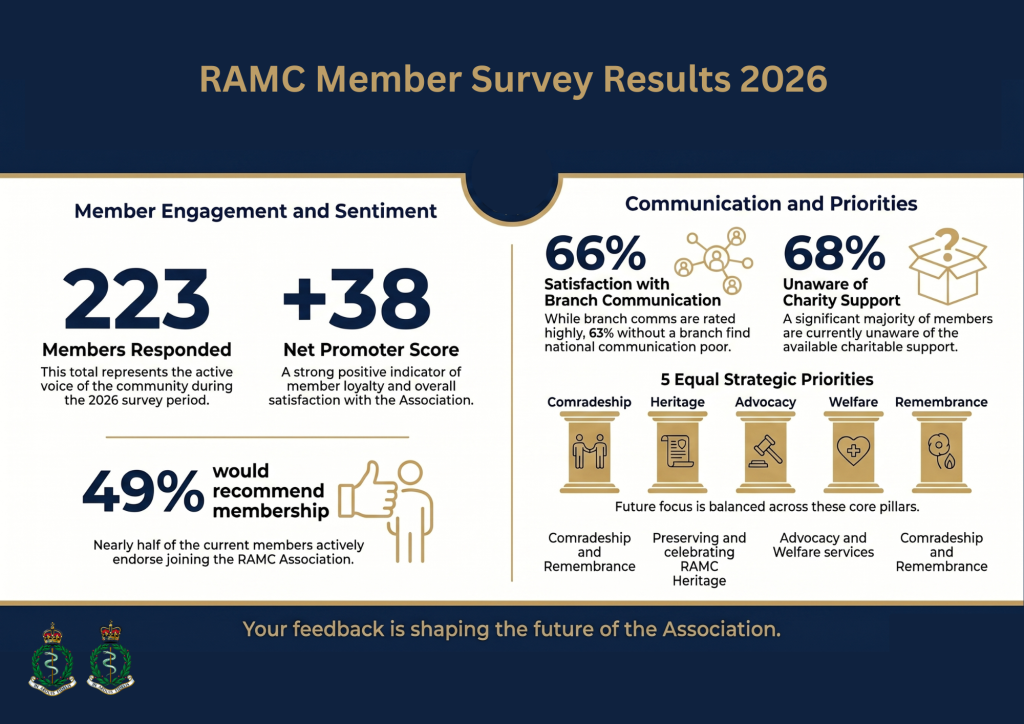
In April 2026, the RAMC Association launched its first ever member survey. We asked for honest, candid feedback on communication, events, welfare, and what the Association means to you. You delivered. 223 members responded, representing more than one in five of our total membership. This is what the RAMC Association member survey found, and what we are doing about it.
Who Responded
The response rate was exceptional, and the spread was broad. Respondents ranged in age from their 30s to their 80s, with the largest groups in the 60 to 69 (37%) and 50 to 59 (24%) brackets. 82% were male and 17% female. In terms of service, 47% served Regular, 25% Reserve, and 24% both.
Geographically, responses came from across the UK and overseas:
-
- England: 78%
-
- Scotland: 9%
-
- Wales: 5%
-
- Northern Ireland: 4%
-
- Overseas: 4%
Importantly, 48% of respondents offered to speak further. We are following up with every one of them.
Communication: Where We Are Falling Short
Communication was the most-discussed topic in the entire survey. Where branches are active and well-led, it works well. 66% of respondents rated branch communication as good or very good.
However, national communication tells a different story. 30% of all respondents rated it as poor or very poor. For members without a local branch, that figure rises to 63%, with none rating it as very good.
Your preferred channel is clear. Email was selected by 173 respondents. Facebook came second (110), followed by branch meetings (97). The website is currently used by only 40 respondents, yet 85 said they would prefer to use it. That gap in demand is one this rebuild must close.
We are regularly posting to Facebook and LinkedIn – If you regularly use other forms of social media please let us know, we will try and incorporate into our social media plan.
What Matters Most to Members
Five Priorities, Almost Equal
You were asked to select what matters most to you as a member. The results came back remarkably level:
-
- Comradeship and social events: 73%
-
- Keeping Corps heritage alive: 69%
-
- Advocating for serving and veteran RAMC personnel: 68%
-
- Welfare and benevolence: 66%
-
- Remembrance: 61%
That near-parity carries a clear message. You see the Association’s purpose as holistic. Comradeship, heritage, advocacy, welfare, and remembrance are not in competition. They are different facets of the same core mission.
The Charity: Invisible, Not Hostile
This section of the RAMC Association member survey produced the most challenging findings. We are not going to dress them up.
68% of respondents said that neither they nor anyone they know has benefited from the Charity. Only 29% trust the Charity to use funds effectively. 22% actively distrust it. Nearly half described themselves as only slightly aware, or not at all aware, of what the Charity does.
The Path Forward Is Visibility
However, the data also shows a clear direction. The primary issue is not hostility. It is invisibility. Members who are more aware of the Charity are substantially more likely to trust it. Most members have never seen evidence of the Charity making a tangible difference. That must change, and it will.
Your top priorities for the Charity are:
-
- Direct financial and welfare support for veterans and families in genuine need
-
- Published breakdowns of how funds are spent
-
- Clear explanations of the rationale behind significant decisions
Representation and Net Promoter Score
49% of respondents would definitely recommend Association membership to others. A further 20% would probably recommend it. 11% would not. The overall Net Promoter Score is +38, which is a solid foundation for an organisation navigating significant change.
A Warning Sign Among Younger Members
Among under-50s, the picture is very different. Only 1 in 12 would definitely recommend membership. 4 in 12 would probably not. That is a pattern the Association must address urgently.
44% feel the Association represents their interests. The largest single group, 42%, is neutral. That neutrality is not indifference. It reflects a membership that is watching, waiting, and willing to give new leadership a chance if it delivers.
Branches: The Strongest Point of Connection
Branch-level representation scores are stronger across the board. 57% feel their branch represents their interests, compared to 44% at national level. Branches remain the primary point of connection between the Association and its members.
176 respondents belong to a named branch. 35 do not, because there is no branch nearby, their branch has closed, or they simply do not know what is available. These members consistently rated their experience poorly across every survey measure.
Areas highlighted as underserved include:
-
- North West: Central Lancashire and Cumbria
-
- East of England: Cambridgeshire
-
- Bristol
-
- Mid-Wales
-
- Parts of Scotland
Several respondents suggested a National Branch or similar category for members who cannot access a physical branch.
Inclusion: Younger Veterans and Women Veterans
Younger Veterans Are Disengaged
Only 15 respondents were under 50, but their signal was consistent. 47% rated national communication as poor or very poor. None would definitely recommend membership. Several reported that this survey was their first contact with the Association since leaving service.
Women Veterans Deserve Better
39 female respondents provided a meaningful sample. 29% disagreed that the Association represents their interests, compared to 14% of male respondents. Some described feeling unwelcome, or said they had been actively discouraged from engaging with their local branch.
Addressing these concerns would benefit the entire membership, not only those specific groups.
What Happens Next
Based on the RAMC Association member survey findings, the Board of Trustees has identified the following priorities:
-
- Improve national communication with regular direct updates to all members, including those without a branch.
-
- Rebuild the Association website to be mobile-friendly, easy to navigate, and a genuine resource.
-
- Make the Charity’s impact visible by publishing what support is available, how funds are spent, and who is being helped.
-
- Expand branch coverage in underserved areas and explore options for members without access to a physical branch.
-
- Engage younger veterans leaving service, so they know the Association exists and what it offers.
-
- Address inclusion and culture, ensuring all members feel welcome regardless of age, gender, rank, or service type.
We will conduct a follow-up survey within the next six months. Your feedback will continue to shape the direction of the Association and the Charity.
Thank you to every one of the 223 members who took the time to respond. Your honesty and willingness to engage are what will make this Association better.